By Troels Richter, founder of StoryPoint.poker
For larger teams, knowing when an estimate is "good enough" just got easier—with real-time alignment tracking across re-estimation rounds.
What's New
Re-estimation is here. Moderators can now re-estimate the same story multiple times, tracking alignment score improvements round-by-round in real time.
No more guessing whether your team needs another round of discussion. Now you can see exactly how alignment improves (or doesn't) with each re-estimation, making it clear when to move on and when to keep discussing.
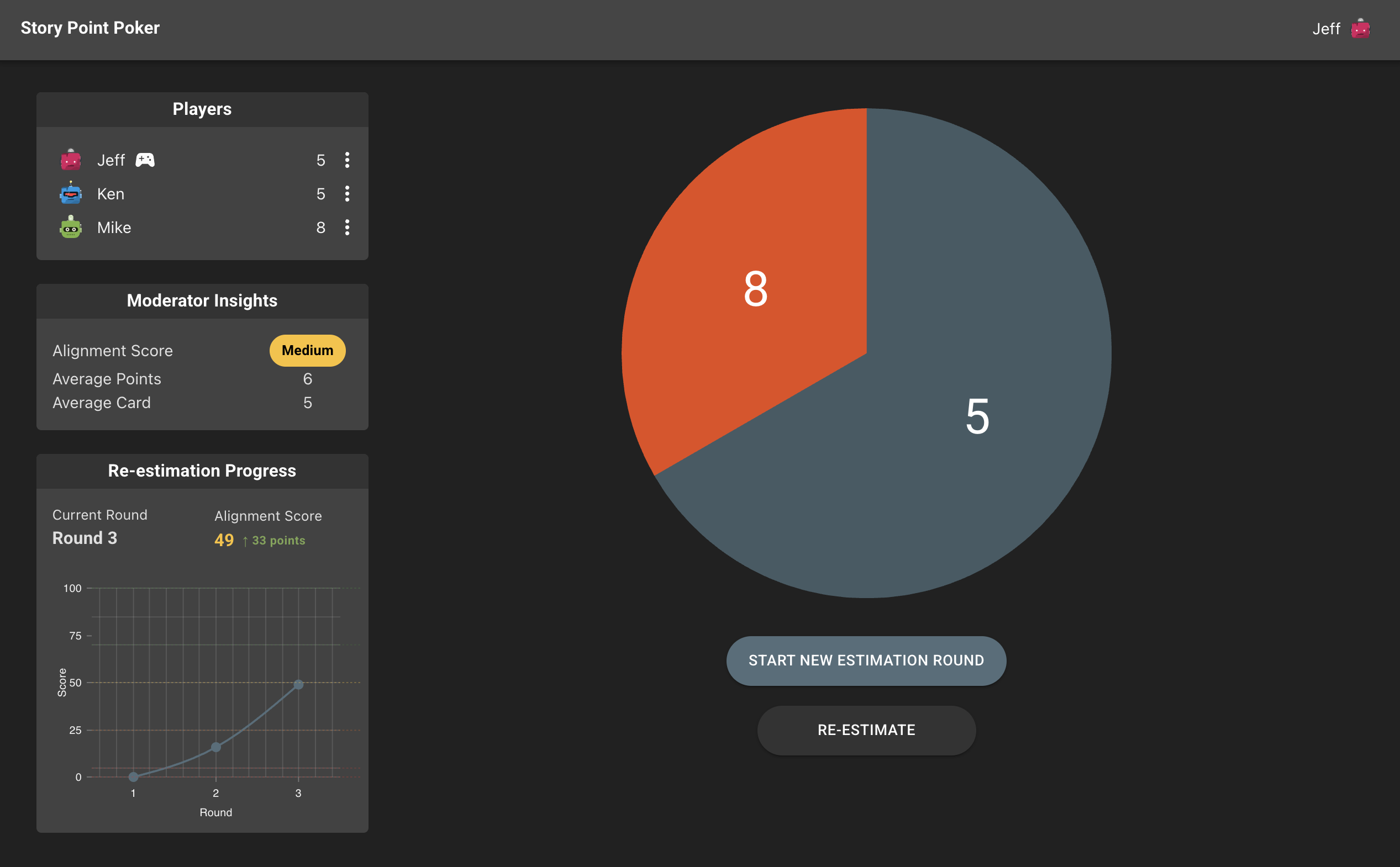
Note: Alignment scores range from 0-100, with descriptive labels: Very low (≤5 points), Low (6-25 points), Medium (26-50 points), High (51-70 points), Very high (71-99 points), and Perfect (100 points).
The Challenge: Making the Call with Larger Teams
Facilitating planning poker with 9+ team members presents a unique challenge: when is an estimate "good enough"?
The data: Analysis of premium user rooms shows that 20.35% of all rooms have 9+ team members. The most common team sizes are 6-8 members (47% of all rooms), with 7-member teams being the single most frequent size (16.10%). Teams with 10-14 members represent 13.71% of all rooms, while teams with 15+ members account for 6.64%—a significant portion where alignment decisions become critical.
With more voices in the room, you get more diverse perspectives—which is valuable—but also more variation in estimates. As a facilitator, you're constantly asking yourself:
- Should we do another round of discussion?
- Are we close enough to move forward?
- Is the team actually getting more aligned, or just going in circles?
The problem: Without clear data, these decisions feel arbitrary. You might stop too early (leaving the team misaligned) or go too many rounds (wasting time on diminishing returns).
The Solution: Round-by-Round Alignment Tracking
Re-estimation with alignment score tracking solves this by showing you exactly what's happening with each round.
See Improvement in Real Time
After each re-estimation round, you see:
- Current alignment score for the round
- Score change from the previous round (↑ improving, ↓ declining, → stable)
- Visual trend graph showing alignment progression across all rounds
Example scenario: Your team starts at 35 points ("Low" alignment). After the first re-estimation, you see +12 points (now 47, "Medium"). After the second round, another +8 points (now 55, "High"). The trend graph shows a clear upward trajectory—you're making progress.
Make Data-Driven Decisions
The alignment score system gives you objective criteria:
- "Low" or "Very low" (≤25 points): Team is far apart. Another round is likely needed.
- "Medium" (26-50 points): Team is getting closer. Consider one more round if time allows.
- "High" (51-70 points): Team is well-aligned. Usually safe to move on.
- "Very high" (71-99 points): Team is highly aligned. Move forward confidently.
- "Perfect" (100 points): Complete consensus. No re-estimate needed.
The critical insight: When you see the score improving round-by-round (+5 to +15 points per round), you know the discussion is working. When scores plateau or decline, it's time to move on or try a different approach.
The Unique Advantage: Round-by-Round Visibility
What makes this feature unique isn't just the alignment score—it's the round-by-round tracking.
Traditional planning poker gives you one alignment snapshot at the end. Re-estimation shows you the journey: how alignment evolves with each round of discussion.
Why this matters for larger teams:
- 9+ members create more estimate variation naturally—and with 20.35% of premium user rooms having teams this size, this challenge affects a significant portion of users
- Without round-by-round data, you can't tell if you're improving or just cycling through different opinions
- With the trend graph, you see the pattern immediately: steady improvement means keep going; flat or declining means try something different
Real-World Impact
Scenario 1: Clear Improvement Path
Team of 12 starts at 28 points ("Low"). After re-estimation round 1: +15 points (43, "Medium"). After round 2: +12 points (55, "High"). The facilitator sees the upward trend and knows the team is converging. One more round might push them to "Very high" territory.
Scenario 2: Diminishing Returns
Team of 10 starts at 45 points ("Medium"). After round 1: +3 points (48, still "Medium"). After round 2: -2 points (46). The trend shows plateauing. The facilitator recognizes that further rounds won't help and moves on.
Scenario 3: Perfect Alignment Achieved
Team of 8 starts at 78 points ("Very high"). After round 1: +22 points (100, "Perfect"). The re-estimate button disappears automatically—the system knows you've reached consensus.
Why This Matters for Facilitators
For larger teams (9+ members), re-estimation with alignment tracking removes the guesswork:
- Objective decision-making: You have data, not just intuition
- Time efficiency: Stop when improvement plateaus, not when you "feel" done
- Team confidence: Show the team their progress visually—they can see alignment improving
- Early intervention: If scores aren't improving after 2-3 rounds, try a different facilitation approach
The critical window: The first 2-3 re-estimation rounds are where most improvement happens. If you're not seeing +5 to +15 point gains per round, something needs to change in your facilitation approach.
Start Using Re-estimation Today
Re-estimation is now available for all moderators. You can:
- Re-estimate the same story to improve team alignment
- Track alignment score changes round-by-round
- See visual trend graphs showing improvement (or lack thereof)
- Make data-driven decisions about when to move on
The data is clear: Teams that can see their alignment improve round-by-round make better decisions about when to stop re-estimating. For larger teams especially—affecting 20.35% of premium user rooms—this removes the ambiguity of "are we close enough?" and replaces it with objective, actionable data.
Try re-estimation today and see how round-by-round alignment tracking helps you make better facilitation decisions.
Re-estimation is available for all registered moderators. Alignment scores are calculated using a logarithmic scaling algorithm that penalizes larger estimate deviations more heavily, ensuring that teams with closer estimates receive higher scores.
Ready to improve your facilitation decisions? Explore StoryPoint.poker and start using re-estimation today.
Published: