By Troels Richter, founder of StoryPoint.poker
See whether your planning poker sessions are actually improving—and when it matters most.
What's New
Alignment Trend Analysis is here. Moderators can now track how their team's estimation alignment evolves over time, session by session.
No more guessing. Now you can see if your team is getting better at reaching consensus and developing shared understanding of work complexity.
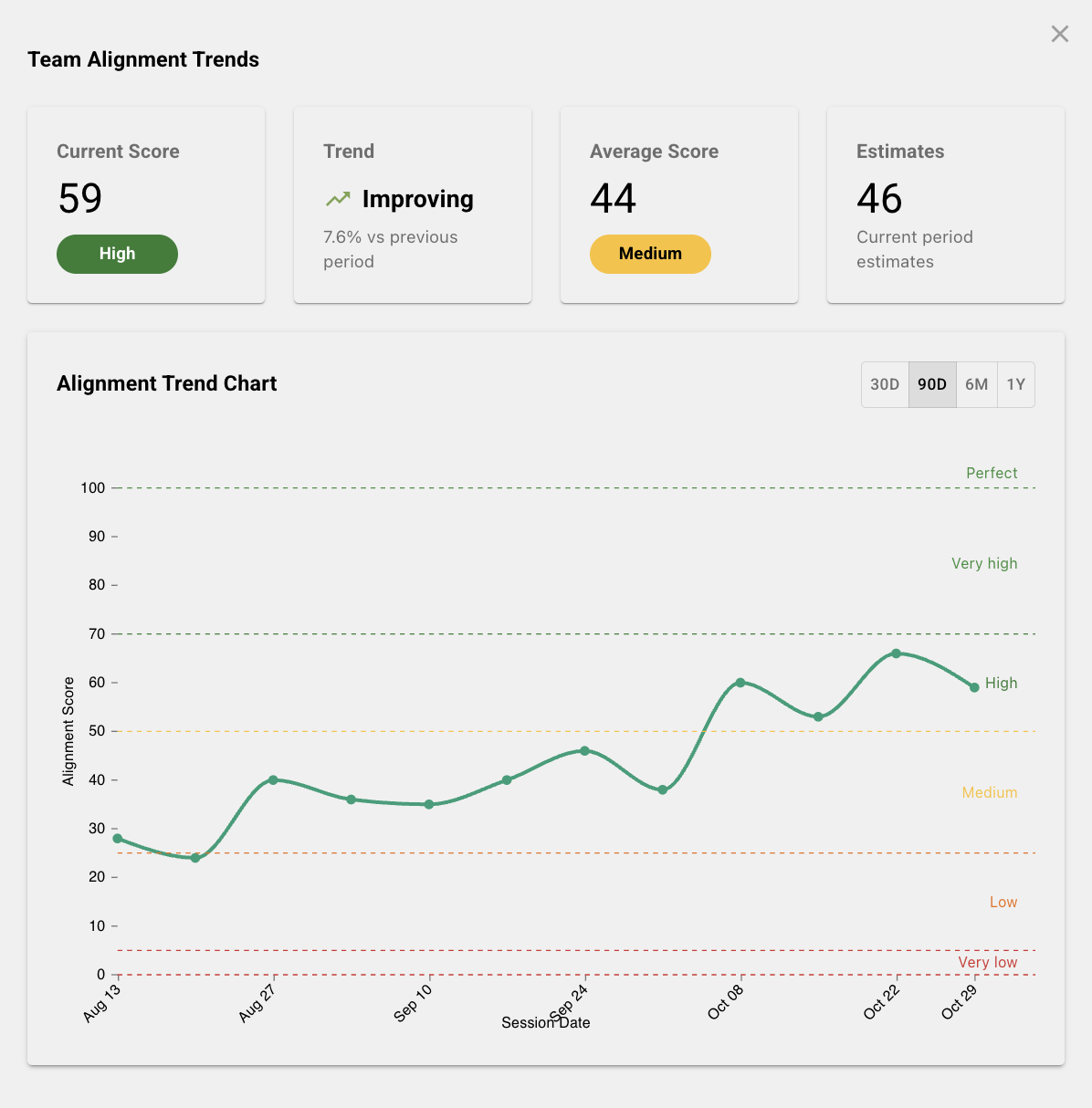
Note: Alignment scores range from 0-100, with descriptive labels: Very low (≤5 points), Low (6-25 points), Medium (26-50 points), High (51-70 points), Very high (71-99 points), and Perfect (100 points).
The Data: What We Learned from 350+ Teams
We analyzed 350+ teams with 3+ months of planning poker practice. Here's what we discovered:
42% of Teams Improve Significantly
157 out of 373 teams (42%) showed measurable improvement—a 5+ point increase in alignment (enough to move from one category to another, e.g., from "Low" to "Medium"). The other 58% didn't improve significantly, showing that improvement isn't automatic.
What this means for teams: A 5+ point improvement represents teams developing better shared understanding of work complexity. When alignment improves, planning sessions become more efficient—less time spent debating estimates, fewer surprises during sprints, and more confidence in sprint commitments. Teams moving from "Low" to "Medium" alignment (or "Medium" to "High") typically see faster planning sessions and more accurate sprint forecasts, as team members increasingly agree on what work truly requires.
Average alignment score across all teams: 48.5 points ("Medium" alignment level)
Improvement Happens Fast
- Half of all improving teams show progress within just 5 sessions (median: ~49 days)
- Most improving teams show progress within 8 sessions (~2 months)
The critical insight: If teams are going to improve, it happens in the first 5-10 sessions.
Substantial Gains When It Happens
- Average improvement: 13.8 points (47% increase)—typically moving teams from "Low" or "Medium" into "High" alignment territory
- Most improving teams see 10-20 point improvements, representing meaningful category shifts (e.g., "Low" to "High" or "Medium" to "Very high")
Very High Alignment Is Rare
We analyzed teams with "Very high" alignment (70+ points) sustained over at least 4 consecutive sessions—a more meaningful measure than single-session peaks. Note: 70+ points represents "Very high" alignment territory (with "High" being 51-70 points, "Very high" being 71-99 points).
- Only 17 teams out of 373 analyzed (4.6%) maintain a "Very high" average alignment (70+ points) with at least 4 consecutive sessions at 70+
- These teams average 25.8 sessions with an 80.7 average alignment score—solidly in "Very high" territory (71-99 points)
- Only 1 team achieved "Perfect" alignment (100.0) across all 19 of its sessions
The takeaway: Even when teams achieve "Very high" alignment (70+), sustaining it consistently is rare. Most teams show variation even at high levels, typically fluctuating between "High" and "Very high," indicating planning poker continues to add value through discussion and consensus-building.
Why This Matters for Facilitators
The critical window: If your team isn't showing improvement by session 8-10, you're entering a critical intervention period.
Early intervention strategy: If your team is stuck in "Low" or "Very low" alignment (below 25 points), or not moving from "Medium" to "High":
- Facilitate deeper discussions—encourage teams to explain estimates
- Clarify story quality—poorly written stories lead to misaligned estimates
- Address estimation norms—ensure shared understanding of story point values
- Schedule a focused retrospective—use alignment data to spark discussion
The window closes fast: Teams that don't improve by session 10 face a steeper climb. Only 20% of improving teams show progress after 24+ sessions.
Start Tracking Today
Alignment Trend Analysis is now available. You can:
- See your alignment trend graph showing session-by-session evolution
- Identify improvement patterns early
- Celebrate progress when your team achieves meaningful gains
- Intervene early if alignment isn't improving
The data is clear: Teams that can see their alignment trends are better positioned to improve. When improvement happens, it happens quickly (within 5-10 sessions) with substantial gains (47% average increase), often moving teams from "Low" or "Medium" alignment into "High" or "Very high" territory.
Try Alignment Trend Analysis today and see how your team's alignment evolves.
Analysis conducted on 350+ planning poker teams with 3+ months of data. Data includes 7,000+ individual estimation sessions. Improvement is defined as a 5+ point increase in average session alignment score from the first half to the second half of a team's data.
Ready to track your team's alignment? Explore StoryPoint.poker and start using Alignment Trend Analysis today.
Published: